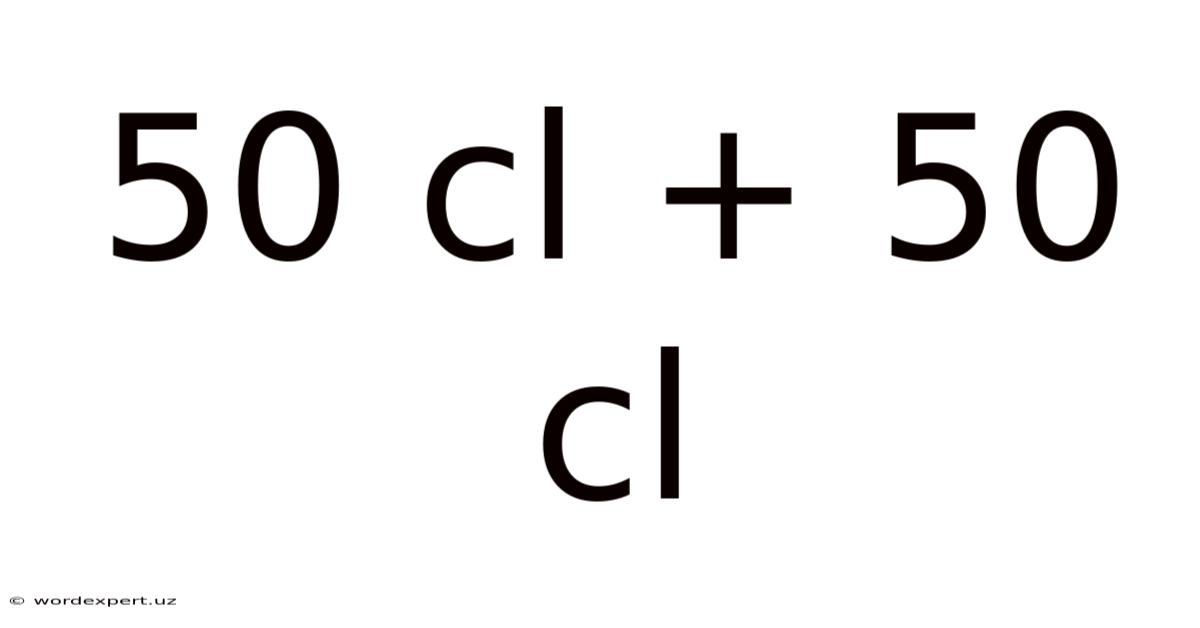
50 cl + 50 cl: Exploring Volume, Measurement, and Applications
This article looks at the seemingly simple equation of 50 cl + 50 cl, exploring its implications beyond basic arithmetic. We'll uncover the meaning of "cl" (centiliters), examine different measurement systems, discuss practical applications of this calculation in various fields, and address frequently asked questions. This exploration will provide a comprehensive understanding of volume measurement and its relevance in everyday life and scientific contexts It's one of those things that adds up..
Understanding Centiliters (cl)
Before we dive into the addition, let's establish a firm understanding of the unit of measurement: the centiliter (cl). Think about it: a centiliter is a unit of volume in the metric system. The metric system, also known as the International System of Units (SI), is a decimal system based on powers of ten, making conversions relatively straightforward That's the part that actually makes a difference..
-
Relationship to Liters: The prefix "centi" means one-hundredth. So, 1 centiliter (cl) is equal to one-hundredth of a liter (L). This can be expressed mathematically as: 1 cl = 0.01 L or 100 cl = 1 L Which is the point..
-
Relationship to Milliliters: Another common unit of volume is the milliliter (ml). Since "milli" means one-thousandth, there are 10 milliliters in 1 centiliter. This means: 1 cl = 10 ml Worth knowing..
Understanding these relationships is crucial for accurate conversions and calculations involving volume.
The Simple Arithmetic: 50 cl + 50 cl
The addition itself is elementary: 50 cl + 50 cl = 100 cl. On the flip side, the significance extends beyond this simple calculation. This result provides a practical understanding of volume aggregation and allows for conversions to other units.
-
Conversion to Liters: Since 100 cl = 1 L, the sum of 50 cl + 50 cl is equivalent to 1 liter (1 L). This simple conversion highlights the ease of working within the metric system Took long enough..
-
Real-World Applications: This basic calculation has numerous applications in everyday life. Consider situations involving liquid measurements in cooking, baking, or mixing drinks. Understanding that two 50 cl containers combined equal 1 liter simplifies tasks and avoids potential errors.
Practical Applications Across Diverse Fields
The concept of adding volumes, such as 50 cl + 50 cl, extends beyond domestic uses and finds applications in several scientific and industrial settings:
-
Chemistry and Laboratory Work: Accurate volume measurement is essential in chemical experiments and laboratory settings. Adding precise volumes of liquids is crucial for achieving the desired reaction or concentration. The principle of 50 cl + 50 cl = 100 cl (or 1 L) directly applies to preparing solutions and conducting experiments.
-
Pharmaceutical Industry: Precise volume measurements are vital in the pharmaceutical industry. Accurate dispensing of medicines and preparing pharmaceutical solutions relies heavily on exact volume calculations. The principles of volume addition are key in ensuring the safety and efficacy of medications.
-
Food and Beverage Industry: From manufacturing to packaging, the food and beverage industry relies on accurate volume measurements. Determining quantities of ingredients, filling containers, and labeling products all involve calculations similar to 50 cl + 50 cl. Maintaining consistency in product volume is crucial for consumer satisfaction and legal compliance.
-
Environmental Science: Measuring water volume in environmental studies is crucial for understanding water resources, pollution levels, and ecological balance. Adding volumes of water samples collected from different locations involves the same fundamental principles But it adds up..
-
Meteorology: While not directly dealing with liquid volumes in the same way, meteorological studies often involve measurements of precipitation (rain, snow). Calculations involving rainfall amounts often work with similar volume-related concepts Simple, but easy to overlook..
Exploring Other Volume Measurement Systems
While the metric system (with its centiliters and liters) is prevalent worldwide, other measurement systems exist:
-
Imperial System: Countries that primarily use the imperial system rely on units like fluid ounces, pints, quarts, and gallons. These units have different conversion factors compared to the metric system. A direct equivalent to 50 cl in the imperial system would be approximately 1.7 fluid ounces.
-
US Customary System: The United States utilizes a slightly modified version of the imperial system. Conversion factors may vary slightly between the imperial and US customary systems.
The importance of understanding different measurement systems stems from the need for accurate conversions and international collaborations in research, trade, and various industries And it works..
Understanding Volumetric Error and Precision
While the addition 50 cl + 50 cl = 100 cl is mathematically straightforward, real-world applications involve potential errors. These errors can stem from:
-
Measurement Instrument Accuracy: The accuracy of the measuring instrument (graduated cylinder, beaker, pipette) directly impacts the precision of the measurement. A less accurate instrument may lead to deviations from the expected 100 cl That alone is useful..
-
Human Error: Errors can also arise from human factors such as improper reading of the measurement scale, inaccurate pouring, or spillage.
-
Temperature Effects: Temperature changes can affect the volume of liquids, particularly with significant temperature fluctuations. This is especially crucial when working with liquids that expand or contract significantly with temperature changes Not complicated — just consistent..
Minimizing these errors requires careful attention to detail, using calibrated instruments, and employing proper measurement techniques Simple, but easy to overlook..
Frequently Asked Questions (FAQ)
Q1: What are some common tools used to measure 50 cl of liquid?
A1: Common tools include graduated cylinders, beakers, measuring cups (specifically those calibrated in milliliters or centiliters), and pipettes (for more precise measurements). The choice of instrument depends on the required level of accuracy and the application.
Q2: How do I convert 100 cl to other units of volume?
A2: As established, 100 cl = 1 L. To convert to other units:
- Milliliters (ml): 100 cl * 10 ml/cl = 1000 ml
- Cubic centimeters (cc or cm³): 1 ml is equivalent to 1 cc, so 100 cl = 1000 cc.
- Cubic meters (m³): 1 L = 0.001 m³, therefore 100 cl = 0.001 m³.
- US fluid ounces: Approximately 33.8 US fluid ounces (conversion factors may vary slightly depending on the specific definition).
Q3: Are there any significant differences between using 50 cl containers versus a single 100 cl container?
A3: While functionally equivalent in terms of total volume, using two 50 cl containers might offer advantages in handling, especially with heavier liquids or when precise portioning is needed. A single 100 cl container might be more convenient for storage and transport, depending on the specific application.
Not obvious, but once you see it — you'll see it everywhere.
Q4: Can I accurately add 50 cl of liquid to 50 cl of a different liquid without considering factors like density and miscibility?
A4: Mathematically, the volume will add up to 100 cl. On the flip side, the resulting volume may not be exactly 100 cl if the liquids have significantly different densities and don't mix perfectly (e.g., oil and water). The total volume may be slightly less than 100 cl due to the different molecular structures and packing of molecules Not complicated — just consistent. But it adds up..
Conclusion
The seemingly simple equation of 50 cl + 50 cl = 100 cl provides a foundation for understanding volume measurements and their widespread applications across numerous fields. From everyday kitchen tasks to sophisticated laboratory experiments, mastering volume calculations and appreciating the significance of units like centiliters is crucial. While the arithmetic is basic, the implications are far-reaching, highlighting the importance of precise measurement in various aspects of science, technology, and everyday life. This comprehensive exploration should equip readers with a deeper understanding of volume, measurement systems, and the practical implications of seemingly simple mathematical operations Less friction, more output..
